
Help Managing a Charlotte Parent's Bills From Out of Town
For adult children living away from an elderly parent in Charlotte, NC: how to get access, set up local bills and mail, and find help on the ground.
If your parent lives in Charlotte and you live somewhere else, you can still help with the bills. With your parent's okay, choose the right kind of access, set up online views and notices for the regular Charlotte bills, get a look at the mail, and find local help for anything that needs someone there. Free county help, such as Just 1 Call, serves families who live elsewhere.
A short call or video check-in each month then keeps you both up to date. This guide covers each step, using the Charlotte companies and county offices your parent actually deals with.

What can you handle from out of town, and what needs someone in Charlotte?
More than you might think can be done from a distance. The National Institute on Aging (NIA) says you can still provide support and assistance as a long-distance caregiver. Its list of ways to help includes helping with finances, money management, insurance claims and paying bills, and helping to find, organize and update important papers and records.
From a distance, you can usually:
- Look at online accounts with your parent
- Pay bills, if your parent asks you to and the account allows it
- Hold a monthly phone or video review of the bills
- Call companies with your parent on the line
Someone in Charlotte is needed for:
- Paper mail that hasn't gone digital
- Documents that must be signed in person
- A check on the house
- A visit to the bank
Decide early who does the local tasks. It might be a brother or sister nearby, a neighbor, a friend, or a paid helper.
Through all of it, remember that it is your parent's money and their decisions. You are helping them run things, not taking over.
What kind of access do you need, and what does your parent keep?
You may not need full control to help. The Consumer Financial Protection Bureau (CFPB) describes several ways a family member can help with bill paying and banking:
- Informal help. You go over the bills together, often on a video call. Under this arrangement, the CFPB says, your parent still signs the checks, and no one else is authorized to make account transactions.
- A convenience account. A helper is added to the account to help with bills. The CFPB notes this does not change the ownership of the money in the account.
- A trusted contact. A person the bank or brokerage firm can contact. Trusted contacts do not have access to your parent's money.
- A power of attorney. A legal document that names someone, called an agent, to act for your parent. Granitefield's page on financial power of attorney has more background.
If a joint account comes up, the CFPB advises making clear you do not want one where the other owner has the "right of survivorship."
Each option gives a different level of access. An elder law attorney in North Carolina can tell you which one fits your parent, what a power of attorney would let you do, and what survivorship would mean for your family.
How do you actually see the accounts? The simplest way is for your parent to open the account and share the screen with you on a video call. You can also call each company with your parent on the line and ask whether it can add you as an authorized person.
Ask your parent's bank what it offers. Call with your parent on the line and ask about alerts by text or email for large or unusual activity, online bill pay, direct deposit for regular income such as a pension or benefits, and statements you can view online. If the bank allows it, your parent may be able to have the alerts sent to you too. Our guide to managing bills for aging parents covers automatic payments in more detail.
Medicare and Social Security have their own rules. Medicare has a form, the Authorization to Disclose Personal Health Information (CMS-10106). Medicare describes it as giving Medicare permission to talk to someone your parent chooses about their claims and health records if your parent can't. That can help when you are the one making calls from another state.
Social Security works differently. It says having a power of attorney or a joint bank account is not the same as being a payee. Managing someone's benefits takes Social Security's own role, called a representative payee. An elder law attorney can explain how that fits with a power of attorney.
Which Charlotte bills should you set up first?
Start with the bills that come every month or every year. Here is what each one lets you do from a distance.
| Bill | What helps from a distance |
|---|---|
| Duke Energy (electric) | Third-Party Notification is a free service. Your parent can name someone to receive Duke's notices: "a relative, friend, neighbor, agency or anyone the customer chooses." The person named is not responsible for paying the bill. |
| Charlotte Water | A CLTWaterHub account lets your parent set up recurring payments, make a one-time payment and choose paperless billing. |
| Mecklenburg County property tax | Taxes are due Sept. 1, with no interest until the first week of the following January. The county's payment options include paying online, through online banking, or by mail. If a mortgage escrow account pays the tax, confirm that with the lender. |
| Vehicle property tax | Under the NCDMV's Tag & Tax Together program, the property tax is paid at the same time as the vehicle registration is renewed. Put the renewal month on a shared calendar. |
| Gas, phone, internet, insurance | Ask each company what it allows: online access, paperless bills, or adding you as an authorized person on the account. |
Duke's notice is just that: a notice. It gives the person named no control over the account. To see each bill as it arrives, open the online account with your parent.
How can you keep track of your parent's mail from another city?
USPS Informed Delivery shows you preview images of incoming mail, and the USPS says Informed Delivery is free to customers. Your parent can set it up for their own address. If they want, they can forward you the daily email, or look at it with you on a call.
It doesn't work everywhere. The USPS says it needs an eligible ZIP Code and a mailbox that is "uniquely coded" to the address, so check whether your parent's address qualifies.
Previews only show what is coming. The paper still lands in Charlotte, so agree on who opens it and how often. One option is a weekly photo of the bills from a nearby helper. Another is a look through the pile during each visit.
Moving bills to paperless, as with Charlotte Water above, cuts down how much has to be opened in person.
Who can help on the ground in Charlotte?
Just 1 Call is a good first call. Mecklenburg County describes it as a one-stop source of information and assistance for seniors and adults with disabilities in the county, and for their families and professional caregivers, "wherever they may reside." It is confidential and free of charge. That means you can call it yourself, from wherever you live.
The Family Caregiver Support Program is run by Mecklenburg County. The person being cared for must live in Mecklenburg County. They must also be over the age of 60, or have Alzheimer's disease or dementia. The program offers referrals to community agencies, education, and funding for respite services (short breaks for the caregiver).
Neighbors and friends. A trusted neighbor or friend can be your eyes for the mail and the house. Your parent can also name a relative, friend or neighbor for Duke Energy's notices, as in the table above.
Private help. Some families want the same person doing documented work every month. Granitefield Financial is based in Fort Mill, SC, and offers daily money management in Charlotte: regular home visits, with the rest done through online access and encrypted document delivery. With your parent's okay, the monthly report can come to you wherever you live. Our page for adult children has more for families helping from a distance.
What if something looks wrong and you're not there?
If someone is in immediate danger, call 911.
Mecklenburg County Adult Protective Services works with disabled adults, 18 years of age or older, who are alleged to be abused, neglected or exploited and who need protective services. Its page lists a 24-hour help line. "Disabled adult" has a set legal meaning, so the county Department of Social Services or an attorney in North Carolina can tell you whether your situation fits.
For money worries, a few practical first steps:
- Call the bank with your parent on the line.
- Look through the online accounts together.
- Write down what you saw, and when.
If your family works with Granitefield, its part is to review your parent's statements, flag activity that doesn't fit, report it to your parent and the family members they authorize, and help you act.
What should a monthly check-in from out of town cover?
A set routine helps you spot small problems early. Here is one you can run from anywhere.
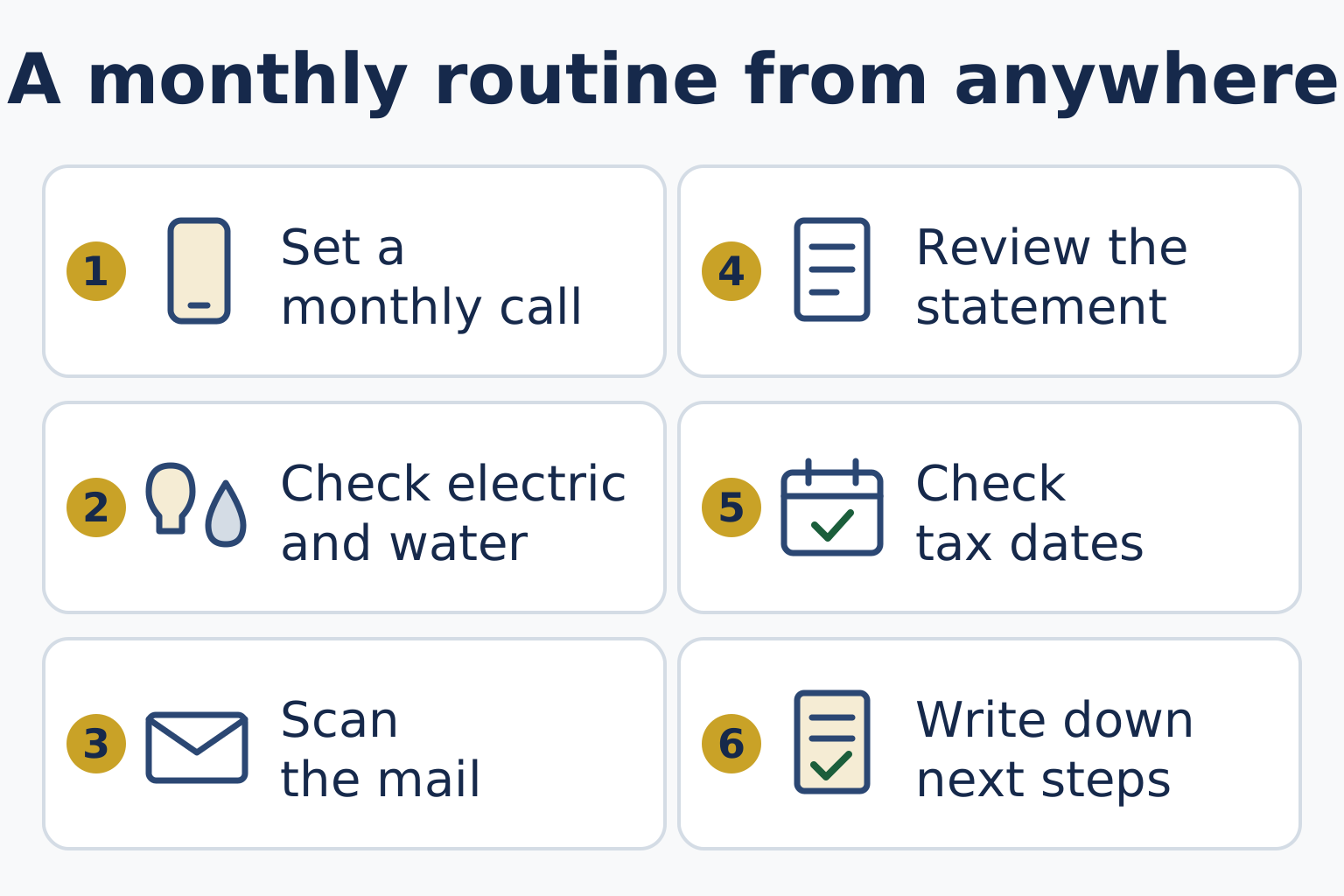
- Set a monthly call. Pick the same day each month for a phone or video check-in with your parent.
- Check electric and water. Open the Duke Energy and Charlotte Water accounts together and confirm last month's bills were paid.
- Scan the mail. Look through the month's mail previews and any paper bills your local helper photographed.
- Review the statement. Go through the bank statement together. Look for anything new, larger than usual, or unfamiliar.
- Check tax dates. County property tax is due Sept. 1, with no interest until the first week of January. The car's tax comes with its registration renewal.
- Write down next steps. Note what you agreed and who does what before the next call.
Every few months, ask your parent whether the arrangement still suits them, and change it if it doesn't.
Frequently Asked Questions
Can I help with my parent's bills if I don't live in Charlotte?
Yes. Much of the work, such as looking at online accounts and a monthly review with your parent, can be done from anywhere, as the National Institute on Aging notes. Line up a local person for the mail and anything that must be done in person.
Can I get Duke Energy's notices about my parent's bill?
Yes. Your parent can sign up for Duke Energy's free Third-Party Notification and name you, or another relative or friend, to receive Duke's notices. The person named isn't responsible for paying the bill. To see each bill as it arrives, open the online account together.
When are Mecklenburg County property taxes due?
Mecklenburg County property taxes are due Sept. 1, with no interest until the first week of the following January. They can be paid online, through online banking or by mail.
Is there free help in Mecklenburg County if I live somewhere else?
Yes. Just 1 Call serves seniors in the county and their families "wherever they may reside," free and confidential. The county's Family Caregiver Support Program is another place to ask.
Do I need a power of attorney to help from a distance?
Not always. The CFPB describes lighter options, such as informal help, a convenience account or a trusted contact. An elder law attorney in North Carolina can explain what a power of attorney would let you do.
Can Medicare or Social Security deal with me on my parent's behalf?
If your parent fills out form CMS-10106, Medicare can talk to someone your parent chooses, such as you, about their claims and health records if your parent can't. A power of attorney or joint account alone does not let you manage your parent's Social Security benefits, because it is not the same as being a payee. That takes Social Security's own representative payee role. An elder law attorney can explain how the two fit together.
Helping from another city takes some setup, but most of it only has to be done once. After that, a monthly call and a local helper carry most of the load. If your family would like regular, documented help, Granitefield's page on daily money management in Charlotte explains how it works, and you can book a short call to talk it through.
Want help with the bills and paperwork? Talk through what you need, and what permission is in place, with Granitefield Financial.