
How to Manage Bills for Aging Parents: Steps and Checklist
For adult children taking over a parent's bills: a step-by-step plan, a printable checklist, NC and SC power of attorney basics, and when to get help.
Start with a conversation and your parent's permission. Then list every bill and source of income, choose the lightest level of access that works, put fixed bills on automatic payment, and keep a calendar for the rest. Review the statements together once a month. Talk with an attorney early about a durable financial power of attorney, and know that Social Security, Medicare and the IRS each have their own rules.
That may sound like a lot. It isn't a reason to panic. It is a reason to have a system, and this guide walks through one step at a time.

Where do I start when my parent needs help with the bills?
Families often notice a few signs first:
- Unopened mail or bills piling up
- Late notices, or a bill paid twice or not at all
- Calls or letters from collectors
- Purchases or payments that seem out of character
- Trouble balancing the checkbook or keeping track of what was paid
- Trouble seeing small print or writing checks because of eyesight or arthritis
None of these proves anything on its own. Together, they are a reason to sit down and talk.
Talk first and decide second. Ask your parent what they want to keep doing and what they would like help with. Many parents don't want someone to take over. They want a backup: a second set of eyes, a reminder before a due date, someone to call when a bill looks wrong.
If your parent is only ready to hand over one bill, start with one bill. Trust grows when the first step goes well.
The Consumer Financial Protection Bureau (CFPB) makes the same point in its guide for people acting under a power of attorney: even when you have to make decisions, ask the person what they want if they can communicate. Your parent's wishes still lead.
If you have brothers or sisters, agree on roles before anyone touches an account. Decide who handles the bills, who gets copies of statements, and how everyone will be kept up to date. A short group message after each monthly review goes a long way.
How do I take over or share my parent's bills, step by step?
Here is the whole plan at a glance. Each step is explained below.
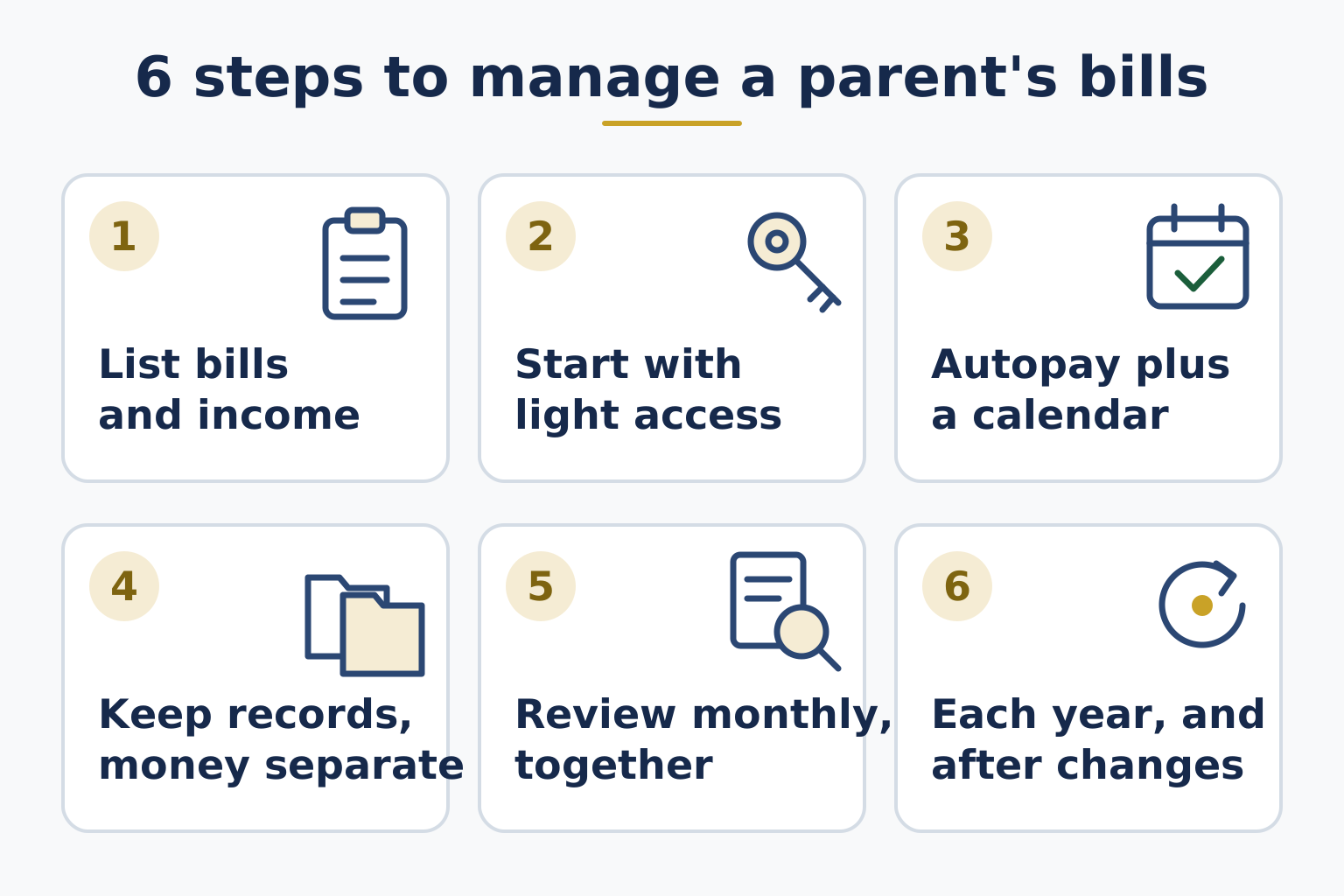
Step 1: Make a list of every bill and every source of income
Sit down with your parent and the last two or three months of mail and bank statements. Write down each bill, its usual amount, its due date, how it is paid today (check, card or automatic payment) and which account it comes from.
Group the bills so nothing slips:
- Fixed monthly bills: rent or mortgage, utilities, phone, internet, insurance premiums.
- Bills that change: credit cards, medical bills, pharmacy.
- Once-a-year or irregular bills: property tax, homeowners and auto insurance renewals, HOA dues, vehicle registration, memberships and subscriptions.
Then list the money coming in: Social Security, pensions, annuities, retirement account withdrawals, rental income and dividends. Note the date each one arrives.
With both lists done, compare them. Does the monthly income cover the regular bills, with room left for the once-a-year ones? If not, that is worth knowing now rather than at renewal time.
It is also a good moment to look ahead. If your parent may need more care later, find out what savings and coverage they have, including any long-term care insurance policy, and where the paperwork is kept. The Eldercare Locator, a public service of the Administration for Community Living, can point you to local services for older adults.
Also note which bills your parent handles online and which accounts they log in to. Keep that list in a locked drawer or a password manager, and ask each bank or company how it lets a family member help, rather than simply using your parent's password.
While you are gathering, find out where the important originals are kept: the will, any trust, the financial power of attorney and advance directives, and whether there is a safe deposit box and who can open it. You don't need to read or change them, only know where they are. An estate planning attorney can answer questions about what they say.
You may find there is no Medicare bill at all. Most people have their Part B premium deducted automatically from their Social Security benefit payment. If your parent does get a bill, Medicare offers online payment and a free monthly withdrawal called Medicare Easy Pay.
If the paperwork itself is the problem, our page on financial organization for aging parents explains how sorting and filing can be done for you.
Step 2: Choose the lightest level of access that works
You do not need full control to help. Start with the least access that does the job, and add more only when it is needed.
| Option | What it means |
|---|---|
| Account alerts or view-only access | You see activity and get alerts for low balances or large withdrawals. Your parent stays in charge. Ask the bank what it offers. |
| Trusted contact person | Your parent's brokerage firm, and some banks, can contact you if they see signs of possible exploitation. You get no access to the money. |
| Convenience signer (also called a convenience account) | You can write checks and pay bills from your parent's account. Who owns the money does not change. |
| Durable financial power of attorney | You act as your parent's agent for the powers the document grants. Durable means it keeps working if your parent can no longer manage their affairs. Signing rules differ in NC and SC, and SC has a recording rule (see below). |
| Social Security representative payee | You manage Social Security or Supplemental Security Income (SSI) payments. Social Security appoints the payee; a power of attorney does not cover this. |
The CFPB's guide to a financial caregiver's options explains several of these. Two points stand out. A convenience account does not change the ownership of the money in it. And trusted contacts do not have access to your parent's money.
A word about joint accounts. Adding your name to your parent's account can look like the simplest fix. The CFPB guide for agents says plainly to avoid joint accounts and to keep your parent's money in your parent's name. Its options guide adds that a joint owner usually gets the money automatically when the other owner dies, which may not match your parent's will. An elder law attorney can explain how a joint account would affect your family's plan.
Step 3: Set up a simple system
The goal is fewer moving parts:
- One account for bills, where possible, with income arriving by direct deposit.
- Automatic payment for fixed, predictable bills.
- A calendar (paper or shared online) for irregular bills, with a reminder a week before each due date.
- Duplicate or paperless statements sent to you, with your parent's okay.
- A small spending account or cash your parent manages on their own. It keeps everyday independence where it belongs.
- Fewer bills, by cancelling services your parent no longer uses, such as old subscriptions, a second phone line or unused memberships.
If you would rather hand this part to someone else, our bill paying services for elderly parents page explains how that works.
Step 4: Keep their money separate and keep records
When you manage money for someone else, the CFPB sets out four basic duties:
- Act only in your parent's best interest.
- Manage their money and property carefully.
- Keep their money and property separate from yours.
- Keep good records.
In practice, that means never mixing your parent's money with your own, keeping receipts and notes even for small expenses, not paying yourself unless the power of attorney or state law allows it, and, as the CFPB puts it, not borrowing, lending or giving your parent's money to yourself or others.
North Carolina and South Carolina law both list a record-keeping duty for agents: keep a record of all receipts, disbursements (money paid out) and transactions made for the principal. The principal is your parent, the person who signed the power of attorney. You can read the duty in North Carolina's agent duties statute and South Carolina's power of attorney act. An attorney can tell you what that duty means in your situation.
A simple ledger works well. For each payment, note the date, who was paid, the amount, the account it came from and where the receipt is saved.
If you sign checks or forms under a power of attorney, sign in a way that shows you are acting as your parent's agent, never with your parent's name alone. The CFPB guide for agents gives an example: a name followed by "as agent for" your parent's name.
Step 5: Do a monthly review together
Set aside 20 to 30 minutes once a month. Go through each statement and check:
- Every bill on your list was paid, and only once.
- Every deposit arrived on time.
- There are no new charges or subscriptions you do not recognize.
- Spending looks normal for your parent.
The CFPB's guide for agents lists warning signs worth noticing, such as money or property that seems to be missing and large cash withdrawals. If your parent is able, do the review with them. It keeps them informed and keeps the decisions theirs.
Step 6: Revisit once a year, and whenever something changes
Once a year, look again at insurance renewals, property tax, Medicare plan choices and tax season. Do the same after any big change: a hospital stay, a new diagnosis or a move to assisted living. Check that the power of attorney and account access still match what your parent wants.
Look after your own finances too. Keep your money separate from your parent's, and if helping is becoming a strain, say so early and share the load.
A printable checklist for managing a parent's bills
Copy this list into a notebook, or print this page and keep the checklist section in your parent's bill folder.
Before you begin
- Talk with your parent about what they want help with
- Agree with siblings on who does what
- Find out whether a financial power of attorney exists and where the original is kept
Gather
- A list of every bill, its due date and how it is paid
- A list of income and the dates it arrives
- A list of online accounts your parent uses
- Bank, credit card and loan accounts
- Insurance policies and premium dates
- Medicare, supplement and drug plan cards
- Last year's tax return
- Property tax and HOA bills
- Subscriptions and memberships
- Contact details for your parent's attorney, CPA, advisor and insurance agent
- Where the will, any trust, the power of attorney and advance directives are kept
- Whether there is a safe deposit box, and who can open it
Set up
- Account alerts
- A trusted contact on investment accounts, and on bank accounts where offered
- Direct deposit for income
- Automatic payment for fixed bills
- A calendar for irregular bills
- Duplicate or paperless statements
- A small spending account for your parent
- Cancel services your parent no longer uses
- Medicare's authorization form (CMS-10106), if you will be calling Medicare
- Apply to Social Security to be the representative payee, if your parent cannot manage benefits
Every month
- Match statements to the bill list
- Confirm deposits
- Flag charges you do not recognize
- Update the ledger and file receipts
- Talk through anything unusual with your parent
Every year
- Review insurance renewals and property tax
- Gather tax documents for the preparer
- Update the bill list
- Confirm the power of attorney still reflects your parent's wishes
Can I pay my parent's bills without a power of attorney?
Often, yes, while your parent can still make and direct their own decisions. They can add you as a convenience signer, set up automatic payments, or pay bills with you sitting beside them.
The gap appears if your parent later cannot manage their affairs. Without a power of attorney, the CFPB's guide to a caregiver's options notes that a court process may be needed to name someone to manage the money.
Many families choose to put a durable financial power of attorney in place while a parent can still choose their agent. An elder law attorney in North Carolina or South Carolina can tell you whether one fits your family. Our financial power of attorney page explains how that role works day to day.
What should North Carolina and South Carolina families know about financial power of attorney?
This section describes the law in general terms. An elder law or estate planning attorney in North Carolina or South Carolina can tell you which document fits your family and how it must be signed.
- Both states use a version of the same model law, the Uniform Power of Attorney Act. North Carolina's is Chapter 32C of its General Statutes. South Carolina's is the South Carolina Uniform Power of Attorney Act.
- Durable by default. In both states, a power of attorney keeps working if your parent can no longer manage their affairs, unless the document says otherwise. See North Carolina's § 32C-1-104 and South Carolina's § 62-8-104.
- When it starts. In both states, it takes effect when signed, unless it names a later date or event. One that starts later is sometimes called a springing power of attorney. See North Carolina's § 32C-1-109 and South Carolina's § 62-8-109(a).
- How it is signed. In North Carolina, your parent signs, or someone else signs for them at their direction and in their presence. The signature is then acknowledged, meaning your parent confirms it before a notary or similar official, and a notarized signature is presumed to be genuine (§ 32C-1-105). In South Carolina, it must be witnessed the same way a will is, and it must also be acknowledged before a notary or otherwise confirmed as South Carolina law sets out (§ 62-8-105).
- South Carolina's recording rule. Once your parent can no longer manage their affairs, a South Carolina agent may act only if the power of attorney has been recorded in the county where your parent lives, the same way a deed is. From that point until it is recorded, the agent's authority cannot be used. It can be recorded before or after that point (§ 62-8-109(c)).
- It ends at death. In both states, a power of attorney ends when the person who signed it dies (North Carolina's § 32C-1-110, South Carolina's § 62-8-110). After that, the estate and any final bills are handled by the Executor (NC) / Personal Representative (SC).
- Using it with banks and companies. The CFPB's guide for agents says to give copies and never give away the original. If a business refuses to accept it, ask for a supervisor, and talk with an attorney if it still will not.
An elder law or estate planning attorney in your state can tell you which form fits your family, how it must be signed, and whether it needs to be recorded. For what to do once the document is signed, see what to do after signing a power of attorney.
Does a power of attorney cover Social Security, Medicare and taxes?
Not automatically. Each of these agencies has its own process.
Social Security. The Social Security Administration says the Treasury Department does not recognize a power of attorney for negotiating federal payments, such as cashing a Social Security payment. The CFPB's guide for representative payees adds that an agent under a power of attorney does not have legal authority to manage federal benefit checks. A joint bank account is not the same as being a payee either.
If your parent cannot manage their Social Security or SSI benefits, Social Security can appoint a representative payee. A person who already holds a power of attorney still has to apply. Payees must use the money for your parent's current needs and keep records of how it was spent or saved.
Veterans benefits have a similar role: a VA fiduciary, a person the VA appoints to manage a veteran's benefits.
Medicare. Your parent can sign Form CMS-10106, which lets Medicare share your parent's personal health information with someone they name. It can be open-ended or limited to set dates.
Taxes. The IRS has its own forms. Form 8821 lets a named person review your parent's tax information. Form 2848 is for representation before the IRS by someone eligible to practice there. A CPA or tax preparer can tell you which one fits.
How do I watch for scams while I manage the bills?
The Federal Trade Commission describes four signs of a scam. Scammers pretend to be from an organization you know. They say there is a problem or a prize. They pressure you to act right away. And they tell you to pay in a specific way, such as gift cards, wire transfers, payment apps or cryptocurrency. Some send a check, tell you to deposit it and send them money, and the check later turns out to be fake.
One simple household rule helps: no payment goes out because of a phone call, text or email. Look up the company's number yourself and call it.
The FTC's scam guide explains how to report one. If you think someone is taking advantage of your parent, North Carolina directs reports to the county Department of Social Services through Adult Protective Services. In South Carolina, SC DSS takes reports by phone or online, and concerns about care in a nursing home or assisted living community go to the Long Term Care Ombudsman. In an emergency, call 911.
What if my parent doesn't want help?
That is common, and it is normal. Your parent has likely paid their own bills for decades. Go slowly. Offer to handle the one bill they find most annoying, keep them in the monthly review, and let them decide what stays theirs.
If talks stall, a neutral person can help: your parent's own attorney, CPA or doctor, or a professional who is not family. The Eldercare Locator, mentioned above, can also point you to local services for older adults.
When does professional help make sense?
Families often bring in help when:
- You live far away.
- Siblings disagree, or one person is carrying all of it.
- The bills are complex: several accounts, medical billing or rental property.
- There has been a hospital stay or a move to assisted living.
- Your parent would rather have a neutral person than a child see every statement.
- You are simply running out of time.
A daily money manager organizes the paperwork, pays bills as authorized, reconciles accounts, watches for unusual activity and flags it, and reports to the family each month. Your parent and family keep the decisions. Our pages on bill paying services and financial organization for aging parents explain what that looks like. If it would help to talk it through, a short call is a fine place to start.
Frequently Asked Questions
Should I put my name on my parent's bank account to pay their bills?
The CFPB guide for agents says to avoid joint accounts and keep your parent's money in their own name. A joint owner usually gets the money automatically at death, which may not match the will. A convenience signer arrangement or a power of attorney lets you pay bills without changing who owns the account. An elder law attorney can explain the effect for your family.
Can I use my parent's power of attorney to manage their Social Security?
No. If your parent can no longer manage their benefits, Social Security can appoint a representative payee, and a power of attorney does not take its place. You can apply to be the payee even if you already hold a power of attorney.
How do I talk to Medicare for my parent?
Your parent can sign Form CMS-10106, which lets Medicare share their information with someone they name. It can be open-ended or for set dates.
Does a power of attorney still work after my parent dies?
No. In both North Carolina and South Carolina, a power of attorney ends when your parent dies. The estate, including final bills, is handled by the Executor (NC) / Personal Representative (SC). An estate planning attorney can explain the next steps.
What records should I keep when paying a parent's bills?
Keep a record of every receipt, payment and transaction. North Carolina and South Carolina law both list this duty for agents. Keep receipts, even small ones, and keep your parent's money separate from yours. An attorney can tell you what that duty means in your situation.
Does a South Carolina power of attorney need to be recorded?
If you act under it after your parent can no longer manage their affairs, South Carolina law requires it to be recorded first, the same way a deed is, in the county where your parent lives. An attorney in South Carolina can tell you whether and when to record it.
Need a clearer financial administration process? Discuss the situation, authorization, and scope with Granitefield Financial.